What Is Human Anatomy?
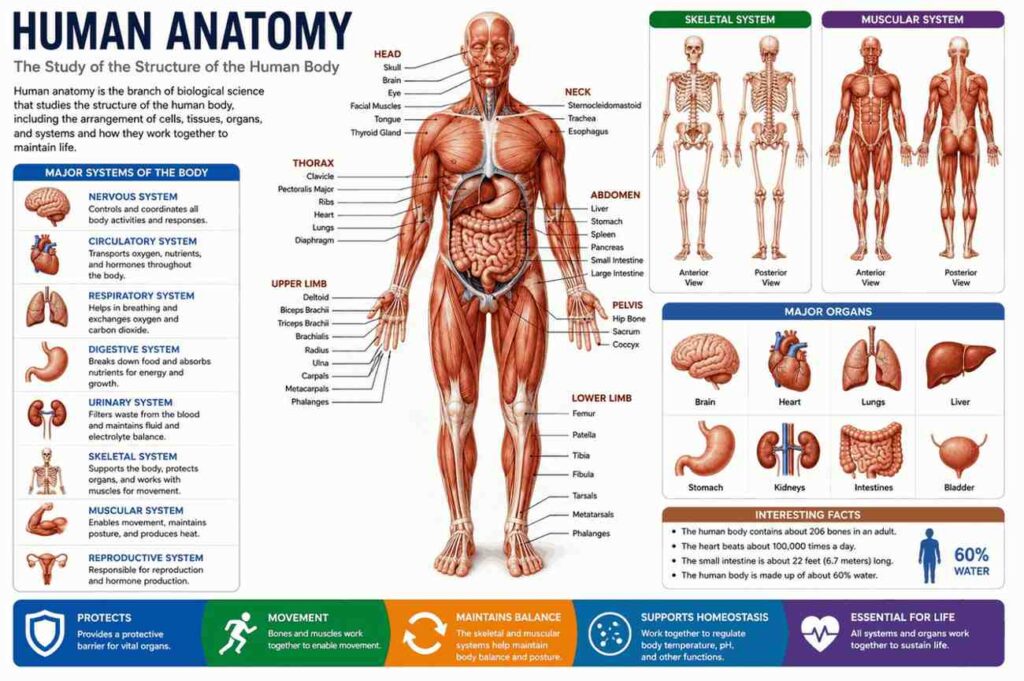
Human anatomy is the branch of science that studies the structure of the human body and the relationship between its various parts. It helps us understand how the body’s organs, tissues, cells, and systems are organized and how they work together to support life.
The word “anatomy” comes from the Greek word meaning “to cut apart”, reflecting the traditional method of studying body structures through dissection. Today, anatomy is studied using a variety of modern techniques, including medical imaging technologies such as X-rays, MRI scans, CT scans, and ultrasounds, which allow scientists and healthcare professionals to observe internal structures without surgery.
Understanding anatomy is fundamental for students, healthcare professionals, yoga practitioners, fitness trainers, and anyone interested in learning how the human body functions.
Why Is Human Anatomy Important?
Human anatomy provides the foundation for understanding health, movement, disease, and medical treatment. By studying anatomy, we gain valuable insight into how the body is structured and how different systems interact with one another.
Knowledge of anatomy helps:
- Understand body functions and movement
- Improve physical performance
- Prevent injuries
- Support medical diagnosis and treatment
- Enhance yoga and fitness practices
- Promote overall health awareness
For yoga practitioners and teachers, anatomy is particularly important because it helps ensure safe alignment, proper posture, and effective movement during practice.
Branches of Human Anatomy
Human anatomy is a broad scientific field that can be divided into several specialized areas of study.
Gross Anatomy (Macroscopic Anatomy)
Gross anatomy focuses on body structures that are large enough to be seen without the aid of a microscope.
Examples include:
- Bones
- Muscles
- Organs
- Joints
- Ligaments
This branch of anatomy is often studied through observation, physical examination, and dissection.
Why It Matters
Gross anatomy helps healthcare professionals and movement specialists understand the visible structures responsible for posture, movement, and overall body function.
Microscopic Anatomy
Microscopic anatomy studies structures that cannot be seen with the naked eye.
These include:
- Cells
- Tissues
- Cellular components
Specialized equipment such as microscopes is required to observe these structures.
Histology
Histology is the study of tissues and their organization within the body.
Cytology
Cytology focuses on the study of individual cells and their functions.
Understanding microscopic anatomy helps researchers and healthcare professionals identify disease processes and understand how cells contribute to overall health.
Anatomy and Physiology: Understanding the Difference
Although anatomy and physiology are closely related, they focus on different aspects of the body.
Anatomy = Structure
Anatomy studies:
- What body parts look like
- Where structures are located
- How body parts are organized
For example, anatomy examines the structure of the heart, muscles, bones, and organs.
Physiology = Function
Physiology studies:
- How body systems work
- How organs perform their functions
- How different systems interact
For example, physiology explains how the heart pumps blood, how muscles contract, and how the lungs exchange oxygen and carbon dioxide.
Why They Must Be Studied Together
Structure and function are closely connected.
A body’s structure often determines its function. Understanding anatomy without physiology can be challenging because knowing how a body part works helps explain why it is designed in a specific way.
The Concept of Homeostasis
One of the most important principles in physiology is homeostasis.
Homeostasis refers to the body’s ability to maintain stable internal conditions despite changes in the external environment.
Examples include regulating:
- Body temperature
- Blood pressure
- Blood sugar levels
- Fluid balance
- Oxygen levels
Maintaining homeostasis is essential for survival and optimal health.
When homeostasis is disrupted, illness and disease can occur.
How Scientists Study Human Anatomy
Modern anatomy relies on advanced technology to examine the body’s structures safely and accurately.
X-Ray Imaging
Used to visualize bones and detect fractures.
MRI (Magnetic Resonance Imaging)
Provides detailed images of soft tissues, muscles, ligaments, and organs.
CT Scan (Computed Tomography)
Produces detailed cross-sectional images of internal body structures.
Ultrasound
Uses sound waves to create images of organs and tissues.
These technologies allow doctors to diagnose medical conditions and monitor treatments without invasive procedures.
Specialized Fields of Physiology
Like anatomy, physiology includes multiple specialized disciplines.
Neurophysiology
Studies the nervous system, including:
- Brain
- Spinal cord
- Nerves
Neurophysiology helps explain processes such as:
- Thinking
- Memory
- Vision
- Movement
- Sensory perception
Cardiovascular Physiology
Focuses on the heart and blood circulation.
Respiratory Physiology
Studies the lungs and breathing mechanisms.
Exercise Physiology
Examines how the body responds to physical activity and exercise.
Cellular Physiology
Investigates how cells function and communicate with one another.
Understanding Structure and Function: The Human Hand Example
One of the best examples of the relationship between anatomy and physiology is the human hand.
The hand’s unique structure includes:
- Multiple small bones
- Flexible joints
- Strong ligaments
- Opposable thumb
These anatomical features allow humans to:
- Grasp objects
- Write
- Use tools
- Perform precise movements
- Operate electronic devices
The function of the hand becomes easier to understand when its anatomical design is studied.
This relationship between structure and function is a fundamental principle throughout the human body.
Why Anatomy Is Important for Yoga Practitioners
For yoga students and teachers, anatomy provides essential knowledge that improves practice safety and effectiveness.
Understanding anatomy helps practitioners:
- Improve alignment
- Prevent injuries
- Understand joint movement
- Increase body awareness
- Enhance flexibility safely
- Develop strength effectively
Knowledge of anatomy also helps yoga teachers modify poses for different body types and physical limitations.
The Role of Anatomy in Healthcare
Healthcare professionals rely heavily on anatomical knowledge for diagnosis and treatment.
Doctors, nurses, physiotherapists, chiropractors, and surgeons use anatomy to:
- Identify injuries
- Diagnose diseases
- Perform surgeries
- Plan treatments
- Educate patients
Without a strong understanding of anatomy, modern healthcare would not be possible.
Conclusion
Human anatomy is the scientific study of the body’s structure and serves as the foundation for understanding health, movement, and human function. From the largest organs to the smallest cells, every part of the body plays a vital role in maintaining life.
By studying anatomy alongside physiology, we gain a deeper appreciation of how the human body is designed and how its structures work together to support everyday activities. Whether you are a healthcare professional, yoga practitioner, student, or simply curious about the human body, learning anatomy provides valuable insights that can improve health, performance, and overall well-being.
Frequently Asked Questions (FAQs)
What is human anatomy?
Human anatomy is the scientific study of the structure and organization of the human body.
What is the difference between anatomy and physiology?
Anatomy focuses on body structure, while physiology focuses on how those structures function.
What are the two main branches of anatomy?
The two primary branches are gross anatomy (visible structures) and microscopic anatomy (structures seen using a microscope).
Why is anatomy important?
Anatomy helps us understand how the body is organized, supports medical diagnosis, improves movement practices, and enhances overall health knowledge.
What is homeostasis?
Homeostasis is the body’s ability to maintain stable internal conditions despite external changes.
What is gross anatomy?
Gross anatomy studies large body structures that can be seen without magnification, such as bones, muscles, and organs.
What is microscopic anatomy?
Microscopic anatomy studies cells and tissues that require magnification to be observed.
Why should yoga teachers study anatomy?
Anatomy helps yoga teachers improve alignment, prevent injuries, understand movement patterns, and adapt practices to individual student needs.

Hi, I’m Amrita Pandey. I specialize in writing about health, pregnancy, yoga, natural remedies, beverages, fruits, and vegetables. I enjoy creating clear, well-researched content that helps readers make informed decisions and build healthier everyday habits.