Smartwatches, rings, smart mattresses and AI apps now claim to understand your nights better than you do. Here is what they can genuinely tell you, what they cannot, and how to use them wisely.
Ten years ago, the only way to learn how you slept was to ask yourself in the morning. Today, a small ring on your finger or a watch on your wrist can hand you a detailed report before you finish your first cup of tea: total sleep time, time spent in deep sleep, resting heart rate, breathing rate and even a “sleep score” out of 100.
No wonder sleep trackers and AI sleep diagnostics are among the most talked-about health technologies of 2026. Contactless sleep trackers, smart under-mattress sensors and AI tools that analyse breathing and movement patterns are appearing everywhere, and more people than ever are curious about their nights.
But are these gadgets accurate? Can they really diagnose anything? And could obsessing over your sleep data actually make your sleep worse? This guide answers all of that in plain language, with practical tips you can use tonight.
Why Sleep Matters More Than Most People Think
Sleep is not idle time. During the night your brain sorts memories, your body repairs tissues, hormones reset and your immune system recharges. Health authorities generally recommend that most adults get at least 7 hours of sleep per night, while teenagers and children need more.
Long-term poor sleep has been linked with weight gain, high blood pressure, weaker immunity, low mood, poor concentration and a higher risk of accidents. Even a few short nights can leave you irritable, hungry for junk food and unable to focus. Because so many people in busy modern lives sleep badly, a tool that promises insight is naturally attractive.
What Is a Sleep Tracker?
A sleep tracker is any device or app that monitors signals from your body while you sleep and turns them into estimates about your rest. Most use a combination of:
- Motion sensors (accelerometers) that detect when you are still or moving
- Heart rate sensors that use light on your skin (photoplethysmography)
- Heart rate variability (HRV), the tiny changes in time between heartbeats
- Blood oxygen (SpO2) and breathing rate estimates
- Skin temperature trends
- Microphones or radar in contactless devices that detect breathing and snoring
What Are AI Sleep Diagnostics?
AI sleep diagnostics use machine learning to look for patterns in all that data. Instead of simply counting movements, the software compares your signals with huge datasets of past sleepers to estimate your sleep stages, detect irregular breathing, or flag possible problems such as sleep apnea.
Some regulators in certain countries have approved specific sleep apnea alert features on major smartwatches. These features are designed to notice patterns that suggest breathing interruptions and encourage you to see a doctor. They are screening alerts, not diagnoses, and that difference is very important, as we will see below.
Types of Sleep Trackers
| Type | How It Works | Pros | Cons |
|---|---|---|---|
| Smartwatch or fitness band | Worn on the wrist | Multi-purpose, easy to find | Can be uncomfortable at night; needs charging |
| Smart ring | Worn on the finger | Small, comfortable, good heart rate data | Sizing matters; usually costlier |
| Under-mattress or bedside sensor | Contactless, detects movement and breathing | Nothing to wear | Can be affected by a partner or pets |
| Smartphone app | Uses phone microphone and motion | Cheap or free | Least accurate |
| Home sleep test kit (medical) | Prescribed device that monitors breathing | Clinically useful | Needs a doctor’s order |
What Do Sleep Trackers Actually Measure?
| Metric | What It Means |
|---|---|
| Total sleep time | How long you were actually asleep, not just in bed |
| Sleep latency | How long it took to fall asleep |
| Awakenings | How often and how long you woke up |
| Sleep stages | Estimated time in light, deep and REM sleep |
| Resting heart rate | Lowest heart rate, often a sign of recovery |
| HRV | A marker of stress and recovery |
| Breathing rate and SpO2 | Clues about breathing problems |
| Sleep score | A brand-specific number that combines several factors |
Understanding Sleep Stages
Your night is made of repeating cycles, each lasting roughly 90 minutes. Within each cycle you move between light sleep, deep sleep and REM (rapid eye movement) sleep.
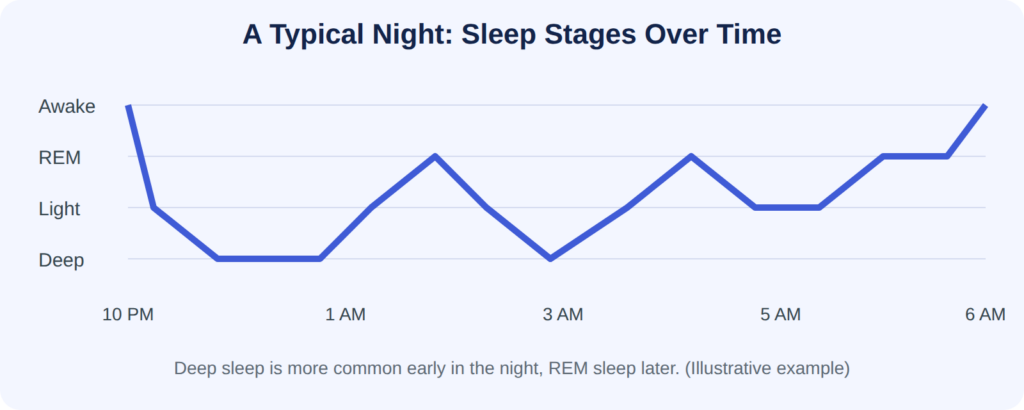
- Light sleep: The gateway stage. Your heart rate slows and your body relaxes. It makes up the largest share of the night.
- Deep sleep: The most physically restorative stage. Growth hormone is released and tissues repair. Deep sleep is more common in the first half of the night.
- REM sleep: The dreaming stage, important for memory, learning and emotional balance. It becomes longer toward morning.
How Accurate Are Sleep Trackers?
This is the most important question, and the honest answer is: good at some things, weaker at others.
The gold standard for measuring sleep is a lab test called polysomnography, which records brain waves, eye movements, muscle activity, heart rhythm and breathing. Consumer devices do not measure brain waves. They estimate sleep from movement and heart signals.
Studies comparing wearables with lab tests generally find that many devices are fairly good at estimating when you fell asleep and woke up and how long you slept overall. They are usually less reliable at telling which sleep stage you were in, and they may confuse quiet wakefulness with light sleep. Accuracy also differs between brands and even between software versions.
Sleep Tracker vs Sleep Study
| Feature | Consumer Sleep Tracker | Clinical Sleep Study |
|---|---|---|
| Measures brain activity | No | Yes |
| Can diagnose sleep disorders | No | Yes |
| Comfort and convenience | High, used at home | Lower, sensors attached |
| Long-term tracking | Excellent | Limited to test nights |
| Cost | One-time device price | Higher, medical fee |
| Best use | Awareness and habit building | Medical diagnosis |
Real Benefits of Using a Sleep Tracker
1. It Builds Awareness
Many people believe they sleep 8 hours when they actually get 6. Seeing the real number can be the push needed to go to bed earlier.
2. It Reveals Patterns
You may notice that late coffee, heavy dinners, alcohol or late-night screens are linked to worse nights. Data makes cause and effect easier to spot.
3. It Encourages Consistency
Going to bed and waking at similar times is one of the strongest sleep habits. Tracker charts show how irregular schedules affect you.
4. It Can Flag Possible Problems
Repeated oxygen dips, very frequent awakenings or persistent loud snoring patterns may be a sign to speak to a doctor. Early awareness can lead to earlier help.
5. It Supports Recovery for Active People
Athletes and regular exercisers use resting heart rate and HRV trends to decide when to train hard and when to rest.
6. It Helps You Test What Works
If you try a new routine, like dimming lights an hour before bed, your tracker shows whether it helps over a few weeks.
Limitations and Risks You Should Know About
Orthosomnia: When Tracking Backfires
Sleep specialists use the term orthosomnia for an unhealthy preoccupation with achieving perfect sleep data. People start worrying about their score, feel anxious at bedtime and end up sleeping worse. If checking your ring or watch makes you tense, take a break from tracking.
False Reassurance and False Alarms
A device that says “great sleep” cannot rule out a disorder. Equally, an alert about breathing may be a false alarm. Neither replaces a medical evaluation.
Inconsistent Sleep Scores
Every brand calculates its score differently. A 78 on one device is not the same as a 78 on another. Compare a single device against its own history, not against friends.
Comfort and Skin Issues
Some people find wearing a device in bed uncomfortable, and tight bands can irritate the skin. Choose a size that fits properly and clean the sensor regularly.
Privacy
Sleep data is deeply personal. Before you buy, read what the company does with your data, whether it is shared with third parties, and whether you can delete it.
Sleep Apnea: The Condition Trackers Are Trying to Catch
Obstructive sleep apnea occurs when the airway repeatedly narrows or closes during sleep, interrupting breathing. Many people with it are never diagnosed. Common signs include:
- Loud, frequent snoring
- Gasping or choking during sleep, often noticed by a partner
- Waking with a dry mouth or morning headache
- Feeling exhausted despite a full night in bed
- Daytime sleepiness, poor concentration or irritability
Untreated sleep apnea is linked with high blood pressure and heart problems, so it is worth taking seriously. If a tracker flags something, or you have these symptoms, see a doctor. They may suggest a home sleep test or a lab study. Effective treatments exist.
Who Can Benefit Most From a Sleep Tracker?
- People with irregular schedules, such as shift workers or students
- Anyone who wants to build a consistent bedtime
- Athletes and fitness enthusiasts monitoring recovery
- People who suspect their sleep is poor but do not know why
- Health-conscious individuals who enjoy data
On the other hand, people prone to anxiety about health or perfectionism may be better off skipping tracking, or using it only for short experiments.
How to Choose the Right Sleep Tracker
- Pick a form you will actually wear. If a watch bothers you at night, consider a ring or a contactless sensor.
- Check battery life. A device that needs charging every night can leave gaps in your data.
- Look at the app. Clear, simple charts are better than confusing dashboards.
- Check for subscription fees. Some devices require a monthly membership for full features.
- Read independent reviews and validation studies rather than only marketing claims.
- Review the privacy policy.
- Set a realistic budget. The most expensive device is not always the most helpful.
How to Read Your Sleep Data the Smart Way
- Track for at least two weeks before drawing conclusions.
- Watch your averages for sleep duration and bedtime consistency.
- Change one habit at a time so you can see what works.
- Ignore small fluctuations. Night-to-night variation is normal.
- Combine data with how you feel. If you feel rested, that matters more than a score.
- Take breaks if tracking causes stress.
10 Habits That Improve Sleep (With or Without a Tracker)
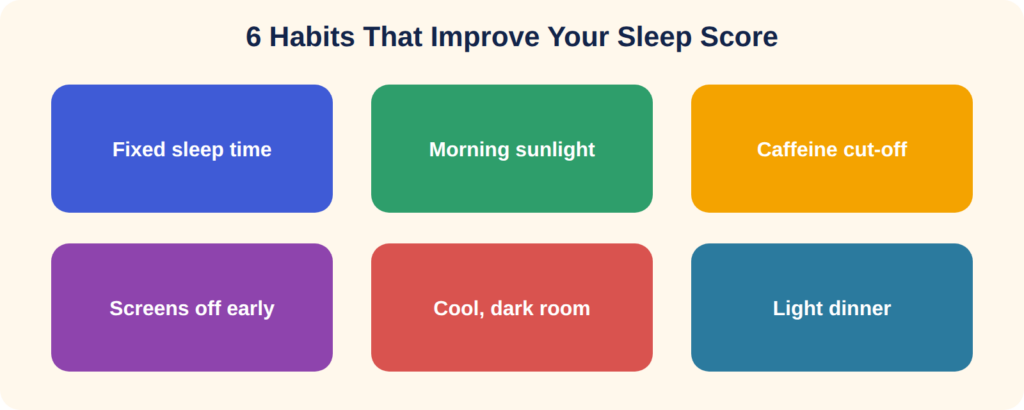
- Keep a fixed sleep and wake time, even on weekends.
- Get morning sunlight. Bright light early in the day helps set your body clock.
- Set a caffeine cut-off. Many people sleep better when they stop tea and coffee at least 8 hours before bed.
- Go easy on alcohol. It may make you drowsy but tends to fragment sleep later in the night.
- Eat dinner earlier and lighter. Heavy meals close to bedtime can disturb sleep.
- Dim the lights and screens for an hour before bed.
- Keep the bedroom cool, dark and quiet.
- Be active during the day, but avoid very intense workouts right before bed.
- Create a relaxing wind-down routine, such as reading, stretching or slow breathing.
- Use the bed for sleep only. Avoid working or scrolling in bed.
Sleep Tips for Indian Households
Hot nights, noisy streets, late dinners and long screen hours are common challenges. A ceiling fan or cooler, light cotton bedding, blackout curtains and earplugs can help. If you work late, try to keep your sleep window as consistent as your schedule allows, and avoid late-night heavy meals and sugary drinks.
Myths and Facts
| Myth | Fact |
|---|---|
| Everyone needs exactly 8 hours | Needs vary, but most adults do well with 7 to 9 hours. |
| A high sleep score means I am healthy | It is only an estimate and cannot detect every problem. |
| Trackers can diagnose sleep apnea | They can only flag possible signs. Diagnosis needs a doctor. |
| More deep sleep is always better | Every stage matters, and stage tracking is not perfect. |
| I can catch up on sleep at weekends | Some recovery is possible, but regular sleep is best. |
Quick Action Checklist
- Decide if tracking helps or stresses you.
- Choose a comfortable, reliable device.
- Track for two weeks before changing anything.
- Fix your bedtime and wake time first.
- Change one habit at a time.
- See a doctor if you have warning signs.
Final Thoughts
Sleep trackers and AI sleep diagnostics are exciting tools. They make an invisible part of life visible, help you notice patterns and can even nudge you toward getting medical help sooner. But they are guides, not judges. Their numbers are estimates, and no score should override how you actually feel.
The winning strategy is simple: use technology to build awareness, use habits to build better sleep, and use your doctor when something seems wrong. Treat your sleep tracker as a helpful coach, not a source of stress, and you will be on the right track to waking up more refreshed.
Frequently Asked Questions (FAQs)
1. Are sleep trackers accurate?
They are usually reasonably good at estimating when you slept and for how long, but less accurate at identifying sleep stages. Use them for trends, not exact numbers.
2. Can a sleep tracker diagnose sleep apnea?
No. Some devices can flag patterns that may suggest breathing problems, but only a doctor can diagnose sleep apnea, usually with a sleep test.
3. How much sleep do I need?
Most adults need at least 7 hours per night. Teenagers and children need more. If you feel rested and alert during the day, you are probably getting enough.
4. Which is better: a smart ring, a smartwatch or a bedside tracker?
The best one is the one you are comfortable using every night. Rings are small and comfortable, watches are multi-purpose, and bedside or under-mattress trackers require nothing to be worn.
5. What is a good sleep score?
It depends on the brand, because each company calculates scores differently. Compare your score with your own past average rather than with other people’s.
6. What is orthosomnia?
It is an unhealthy obsession with getting perfect sleep data, which can cause anxiety and worsen sleep. If you notice this, take a break from tracking.
7. How much deep sleep and REM sleep should I get?
The split varies by age and person, and consumer trackers estimate it imperfectly. Instead of chasing numbers, aim for enough total sleep, regular timing and feeling refreshed.
8. Do sleep tracking apps on phones work?
They can give a rough idea of sleep time and snoring, but they are generally the least accurate option compared with wearables and dedicated sensors.
9. Can sleep trackers improve my sleep?
Not by themselves. They help you spot patterns and build awareness. Improvement comes from acting on the insights with better habits.
10. When should I see a doctor about my sleep?
See a doctor if you have loud snoring with breathing pauses, constant daytime tiredness, difficulty sleeping for several weeks, or if your tracker repeatedly flags unusual breathing or oxygen levels.
Disclaimer: This article is for general information and education only and is not medical advice. Sleep trackers are not medical devices for diagnosis. Please consult a qualified healthcare professional about any sleep or health concern.

Hi, I’m Amrita Pandey. I specialize in writing about health, pregnancy, yoga, natural remedies, beverages, fruits, and vegetables. I enjoy creating clear, well-researched content that helps readers make informed decisions and build healthier everyday habits.