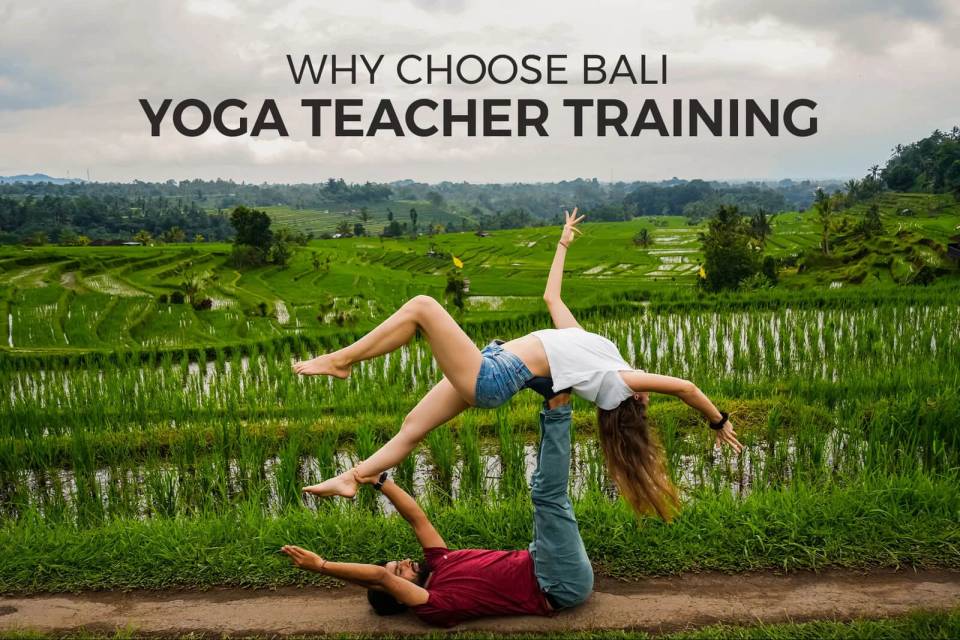
Bali holds a reputation in the yoga world that few other destinations can match, and it isn’t accidental. The island’s Hindu culture treats ritual, ceremony, and spiritual practice as part of daily life rather than something set apart for tourists — daily offerings, temple ceremonies, and purification rites are simply how Bali functions. Practicing and studying yoga against that backdrop feels fundamentally different from training in a converted studio space back home.
That cultural depth is only part of the story. Over the past two decades, towns like Ubud, Canggu, and Uluwatu have built up genuine infrastructure around yoga education — experienced senior teachers, established retreat centers, and a density of Yoga Alliance–registered schools that smaller destinations simply haven’t had time to develop. Ubud in particular is often mentioned alongside Rishikesh in India as one of the world’s true centers for yoga teacher training, and the annual Bali Spirit Festival each May draws practitioners and teachers from around the world.
Climate plays a practical role too. Bali’s tropical weather stays in the 26–30°C range year-round, which means open-air shalas — the traditional pavilion-style studios surrounded by jungle or rice terraces — are usable almost every day, rain season included, since most are covered.
For anyone considering a 200-hour (or higher) teacher training specifically, Bali also offers something harder to quantify: time. Most programs run as immersive residential blocks of two to four weeks, away from work and daily distractions, which is part of why so many graduates describe the experience as genuinely transformative rather than just a certification exercise. But with dozens of schools competing for the same students, the marketing language across websites tends to blur together — which is exactly why the specifics below matter more than the taglines.
Bali has become the world’s most concentrated hub for yoga teacher training (YTT), and that popularity is exactly what makes choosing the right school harder than it should be. Dozens of programs use nearly identical marketing language — “authentic,” “transformative,” “life-changing” — so the real differentiators come down to specifics: who’s actually teaching, what’s included, how big the group is, and whether the certification is properly recognized. Here’s an honest, detail-first look at ten of the island’s established training schools.
1. Blooming Lotus Yoga — Ubud
Set in the village of Mawang, Lodtunduh, about 15 minutes south of central Ubud, Blooming Lotus Yoga has run teacher trainings out of Bali for more than a decade and holds Yoga Alliance Registered Yoga School status. Its 200-hour program runs as a 23-day immersion, priced from roughly US$2,879 including accommodation and meals, and graduates qualify for RYT-200 registration plus YACEP continuing-education credit. The property sits above the Wos River facing a traditional temple, with accommodation in open-concept villas that each include a private plunge pool — a notably more comfortable setup than the shared-dorm format common at budget schools. Meals are organic and vegan, served at the on-site restaurant, and group sizes are historically capped around 16 students, which keeps the training genuinely personal rather than lecture-hall scale. Independent reviews consistently highlight the depth of the anatomy and philosophy modules and describe the teaching staff as attentive across skill levels — a meaningful signal for a training format that’s often thin on real instructor engagement.
2. Bali Yoga School — Canggu & Uluwatu
Bali Yoga School runs 200-hour, Yoga Alliance–certified (USA and International) trainings out of two locations — Canggu and Uluwatu — built around Hatha, Ashtanga, and Vinyasa. The Uluwatu program runs as a 25-day course set about 15 minutes from the beach, framed around personal transformation as much as technical instruction, while the Canggu training follows a similar residential structure. Group sizes run larger than some competitors — up to 25–30 students — which keeps per-student cost down but means less one-on-one instructor time than smaller schools offer. It’s a reasonable fit for students who want flexibility in location (surf town versus clifftop) without switching schools.
3. Ulu Yoga — Uluwatu
Ulu Yoga has been training teachers in Uluwatu for over a decade, from an ocean-view shala just minutes from Uluwatu’s beaches and the surf village of Bingin. Its core 200-hour multi-style training (Hatha and Vinyasa, with yin, functional anatomy, and hands-on adjustment work included) runs across 14–28 day formats depending on intake, with a class size of 15–25 students and a requirement of at least 20 hours of recent yoga practice before enrolling. A distinguishing feature is the built-in 100 hours of required online pre-study, which front-loads theory before students arrive — useful for people who want to spend on-site time on practice and teaching rather than lecture-heavy content. Ulu Yoga also runs specialty aerial and 300-hour yin trainings, making it a reasonable option for teachers looking to stack credentials at one location over time.
4. Bali Yoga Ashram
Bali Yoga Ashram describes itself as operating for over 20 years and is Yoga Alliance registered, offering a full ladder of certification — 100, 200, 300, and 500-hour programs — built around Ashtanga Vinyasa and Vinyasa Flow, with a Yin-Vinyasa track also available. Its 500-hour pathway (200 + 300 hours combined) is a genuine differentiator for students planning to go beyond entry-level certification without switching schools, and it also runs a 200-hour Hatha + Ayurveda combined course for students interested in the broader Vedic health system alongside asana training. The school positions itself at the more affordable end of Bali’s YTT market — worth confirming current pricing directly, since “affordable” programs vary widely in what’s actually included (accommodation, meals, and excursions are sometimes separate line items).
5. Anandam Yoga School — Canggu
Anandam Yoga School runs its Bali programs from Tibubeneng in Kuta Utara, close to Canggu, with a 200-hour multi-style curriculum spanning Hatha, Ashtanga, and Vinyasa across a 21-day immersion, and a 300-hour advanced program for RYT-200 holders. It’s Yoga Alliance certified (RYT-200 and RYT-300) and also operates a sister training location in Germany, giving graduates a “global path” option for advanced or specialized modules. Course pricing is positioned in the $1,600+ range depending on inclusions. Reviewers frequently mention the anatomy instruction and the lead teachers’ grounding in Indian yogic lineage as standouts, and the Tibubeneng setting — described as a quieter village base with private bungalows and vegetable gardens — offers a middle ground between full jungle isolation and Canggu’s busier center.
6. Radiantly Alive — Ubud
Radiantly Alive runs its 200-hour and 300-hour RA Vinyasa trainings directly out of its long-standing Ubud studio in the center of town, with a distinguishing feature worth noting: the lead and supporting teachers are resident faculty who teach year-round at the studio, not visiting instructors brought in only for the training block. The 200-hour program runs as a roughly 24-day immersion combining daily pranayama, asana, and philosophy sessions, and the studio also offers Spanish-language training cohorts — a genuine rarity in Bali’s largely English-dominated YTT market. Training here is non-residential, meaning students arrange their own accommodation in Ubud, which suits people who prefer choosing their own lodging over an all-inclusive package.
7. Loka Yoga School — Kedungu (near Canggu)
Loka Yoga School operates from Bali Yoga Shala in Kedungu, a quieter beachside area about 15 minutes from Canggu’s center. Its 200-hour Hatha-Vinyasa training (also incorporating Yin, Ashtanga, and Kundalini elements) is capped at a maximum of 20 students and is taught exclusively by E-RYT senior teachers with 15–30 years of experience each — the school states explicitly that interns or newly certified teachers never lead training sessions, which is a meaningful quality signal in a market where junior staff sometimes cover instruction. The school has operated since 2016 across both India and Bali.
8. Trimurti Yoga
Trimurti Yoga has run its 200-hour training for roughly 15 years and is Yoga Alliance USA registered. Its 21-day course is built around a traditional ashram-style immersion and includes guidance on starting a yoga school or studio post-certification — a practical addition for students planning to teach independently rather than at an existing studio. The emphasis throughout is on classical technique and philosophy over a heavily modernized curriculum.
9. Samadhi Yoga Ashram
Samadhi Yoga Ashram runs a 20-day, 200-hour multi-style program (Hatha, Ashtanga, Vinyasa, and Yin) taught using the traditional “gurukul method” — revisiting every subject area daily rather than covering each topic once and moving on. Teachers are described as trained in the Himalayan tradition, and the school also operates a flagship location in Rishikesh, India, for students who want to continue training across both settings. It’s Yoga Alliance USA certified and builds toward 300 and 500-hour advanced tracks.
10. Joga Yoga Training — Canggu
Joga Yoga Training runs a structured 200-hour program in Canggu covering Hatha, Vinyasa, Ashtanga, and Yin, with particular emphasis on teaching practice, alignment, and sequencing rather than a heavy philosophy-only focus. Pricing is transparent and tiered by accommodation option (roughly €1,550–€2,999), and the school publishes independent comparison guides on its own site — including direct links to verify its Yoga Alliance registration — a level of transparency that’s less common among smaller operators.
How to Actually Choose Between Them
A few questions cut through the marketing noise faster than anything else:
- Is the school Yoga Alliance registered, and can you verify it? Yoga Alliance maintains a public directory — check the school’s registration directly rather than taking a badge on their homepage at face value.
- Who is teaching, specifically? Ask whether the instructors listed on the website are the ones actually leading your cohort, and how long they’ve been with the school.
- What’s the group size? Anywhere from 15 to 30 students is common; smaller groups generally mean more individual feedback on your teaching practice, which is the part of YTT that’s hardest to self-study.
- What’s genuinely included? Accommodation, meals, excursions, and post-course support vary enormously between programs quoting similar headline prices.
- Residential or non-residential? Some programs (like Radiantly Alive’s Ubud training) require you to arrange your own accommodation, which can be cheaper but adds logistics.
Bali’s YTT market is large enough that there’s no single “best” school — the right fit depends on whether you want a jungle ashram immersion, a beach-adjacent training with surf access, or a smaller boutique cohort with senior teachers only. Confirm current dates, pricing, and instructor rosters directly with each school before booking, since these details shift from year to year.
Frequently Asked Questions
Do I need prior yoga experience to join a 200-hour YTT in Bali? Most schools accept complete beginners, though some — like Ulu Yoga — ask for at least 20 hours of recent practice beforehand. If you’re new to yoga, it’s worth building a few months of consistent practice before enrolling so you can keep up physically with daily multi-hour training sessions.
How long does a 200-hour teacher training in Bali actually take? Most programs run 20–28 days on-site, though the exact schedule (and how much, if any, pre-study is required online) varies by school. Ulu Yoga, for example, requires 100 hours of online coursework in addition to the on-site training.
Is Yoga Alliance certification the same everywhere? No — schools can be registered at different levels (RYS 200, RYS 300, etc.) and the certification a student receives depends on completing a program at a properly registered school. Always verify a school’s registration directly through Yoga Alliance’s public directory rather than relying on a badge shown on the school’s own website.
What’s the typical cost of a 200-hour YTT in Bali? Prices generally range from around US$1,500 to US$3,000+, depending on accommodation type, group size, and what’s included (meals, excursions, massages, airport transfers). Lower-cost programs aren’t necessarily lower quality, but it’s worth confirming exactly what’s bundled into the price versus billed separately.
Which location is best — Ubud, Canggu, or Uluwatu? Ubud offers the most traditional, spiritually focused setting and the largest concentration of long-running schools. Canggu suits students who want a livelier, more social base with easy beach and café access. Uluwatu appeals to surfers and those wanting a quieter, cliffside setting away from town traffic. None is objectively “better” — it depends on the kind of immersion you want.
Can I do a teacher training even if I don’t plan to teach afterward? Yes — many students complete a 200-hour YTT purely to deepen their personal practice, and most schools welcome this openly rather than requiring a stated intention to teach professionally.
What should I check before booking any school? Confirm the school’s Yoga Alliance registration status, ask who the actual instructors will be for your specific cohort, check the maximum group size, and get a clear breakdown of what’s included in the quoted price versus what costs extra.
Hi, I’m Amrita Pandey. I specialize in writing about health, pregnancy, yoga, natural remedies, beverages, fruits, and vegetables. I enjoy creating clear, well-researched content that helps readers make informed decisions and build healthier everyday habits.